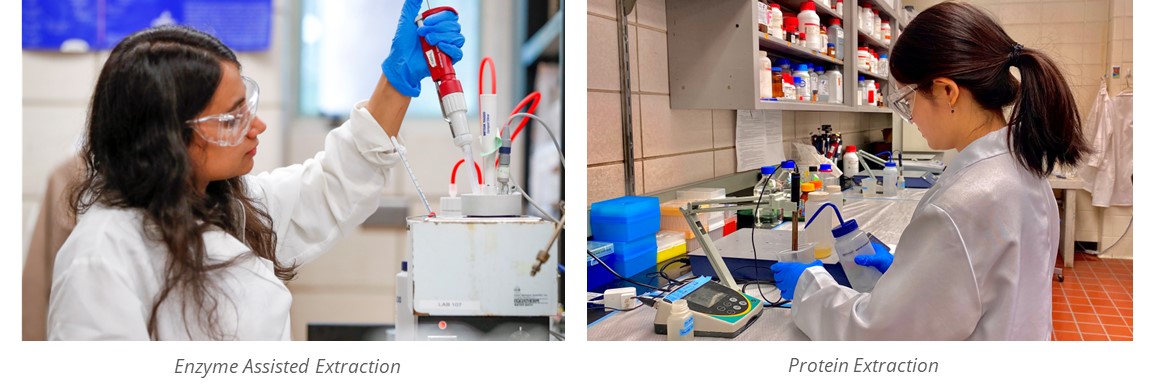
Protein Extraction
| Analysis | Instrument(s) | Purpose |
|---|---|---|
| Alkaline Extraction |
| To extract protein from plants or alternative sources using alkaline methods |
| Ultrafiltration Assisted Salt Extraction |
| To extract protein from plants or alternative sources by adding salt and using ultrafiltration |
| Enzyme Assisted Extraction |
| To enhance protein extraction methods with appropriate enzymes |
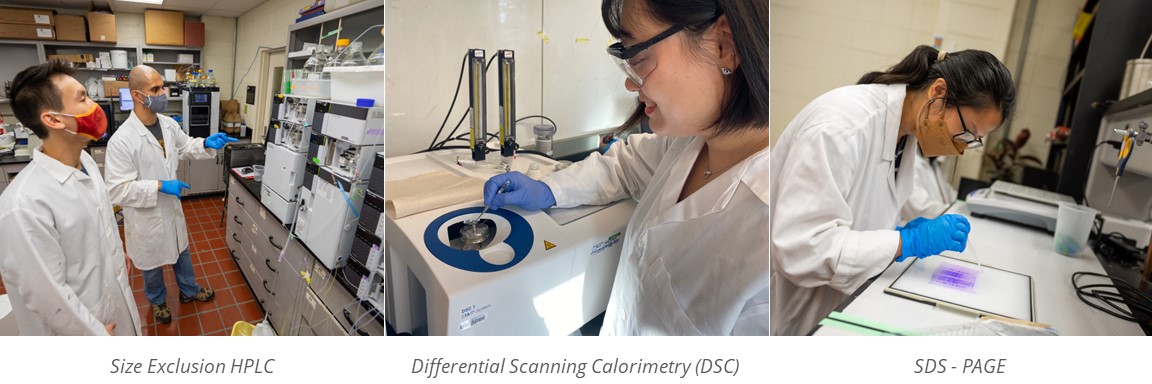
Structural Characterization
| Analysis | Instrument(s) | Purpose |
|---|---|---|
| Protein Profile via One or Two-Dimensional Gel Electrophoresis |
| To determine the protein profile under reducing and non-reducing conditions To reveal polymerization and/or hydrolysis patterns, potential bonding mechanisms, and the prevalence of individual protein subunits |
| Molecular Aggregation via Surface Hydrophobicity |
| To determine protein unfolding and subsequent polymerization driven by hydrophobic interactions To estimate hydrophobic surface area and changes throughout processing |
| Molecular Aggregation via Surface Charge (Zeta-Potential) |
| To estimate the net charge density on the surface To indicate any changes in surface hydrophilicity, protein unfolding, and possible interactions with macromolecules such as carbohydrates |
| Molecular Aggregation via Free Sulfhydryl Concentration |
| To indicate any protein unfolding and to reveal free SH that were previously entrapped in the three dimensional structure of the protein To determine the redox state of the protein |
| Particle size analysis of powders, liquids, and emulsions |
| To measure particle size of powders, liquids, and emulsions |
| Degree of Hydrolysis using OPA method |
| To determine the degree of hydrolysis and the extent of amine blocked by the Maillard reaction |
| Structural Denaturation using Differential Scanning Calorimetry (DSC) |
| To determine the onset temperature of denaturation and the degree of unfolding as affected by processing or modification To estimate protein denaturation state |
| Protein secondary configuration by FTIR |
| To measure the distribution of secondary protein structures as affected by processing conditions or modification |
| Protein Tertiary Structures by Surface Enhanced Raman Spectroscopy (SERS) |
| To determine the distribution of tertiary protein structures and intramolecular interactions as affected by processing conditions or modification |
| Apparent Protein Aggregation State by Size Exclusion HPLC |
| To identify degree of polymerization, the extent of intermolecular aggregation with covalent and non-covalent linkages, and molecular weight of polymer distribution |
| Aggregation via Transmission-Scanning Electron Microscopy |
| To visualize protein and particle dynamics (aggregation morphology) |
| Chemical Deviation Matrix-Assisted Laser Desorption/Ionization-Time of Flight (MALDI-TOF) |
| To determine the individual protein subunit/peptide molecular weights, which can be used for identification of different protein subunits To identify changes in proteins and peptides profile/distribution as affected by processing and/or enzyme modification To monitor the site of modification |
| Chemical Deviation via LC/MS/MS |
| To separate and identify specific protein subunits |
| Structural Visualization via Confocal Laser Scanning Microscopy (CLSM) |
| To visualize protein-protein and protein-lipid interactions in dispersed systems while utilizing fluorescent probes |
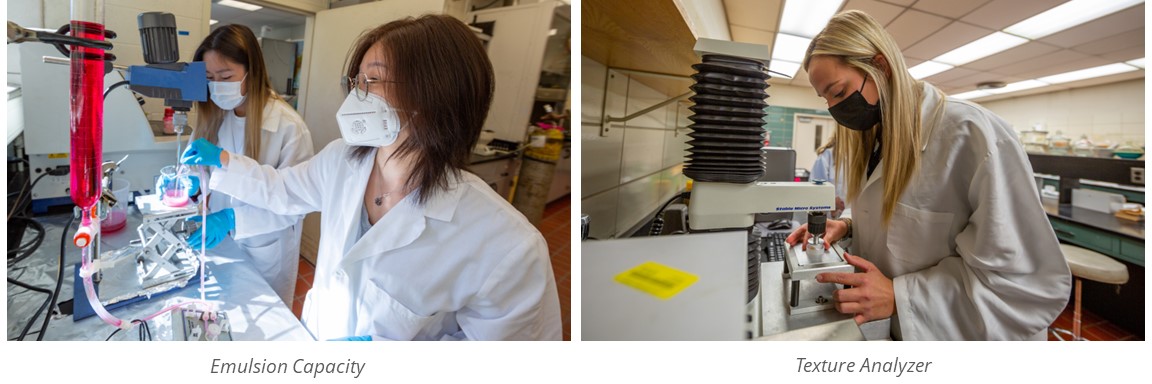
Functional Characterization
| Analysis | Instrument(s) | Purpose |
|---|---|---|
| Solubility |
| To determine the soluble protein in a protein-water dispersion by measuring the protein concentration of the dispersion before and after centrifugation to sediment insoluble proteins. |
| Oil-Binding Capacity |
| To determine the amount of oil bound to the protein structure. Oil-binding capacity is related to a protein's surface hydrophobicity and influences its emulsification properties. |
| Water-Binding Capacity |
| To determine the amount of water bound to protein via hydrogen or ionic bonds. |
| Gelation and Least Gelation Capacity |
| To determine a protein's ability to form a three-dimensional network with entrapped water. Gel strength measures the force required to rupture the gel. Least gelation concentration determines the lowest protein concentration at which a protein solution forms a heat-induced gel and holds its shape. |
| Foaming Capacity & Stability |
| To determine a protein's ability in a protein solution to produce a foam after agitation. Foaming stability, on the other hand, refers to the ability of a protein foam to remain stable over time, and against gravitational or mechanical stresses. |
| Emulsification Capacity |
| To determine the quantity of oil a certain amount of protein can emulsify. Oil is titrated into a protein solution and emulsion failure is measured by a decrease in viscosity. |
| Emulsification Activity Index and Stability |
| To determine the amount of oil that can be emulsified per unit protein. Emulsification stability is given in the number of minutes that the emulsion will be stable. |
| Color Analysis |
| To determine L*a* b* values of protein ingredients as affected by extraction conditions, glycation, processing conditions, etc. |